Tel: +256-778-404-397
E-mail: info@kyenjojo.go.ug
Mityana District Local Government has undertaken a nutrition benchmarking visit to Kyenjojo District Local Government in a bid to enhance strategies aimed at improving household nutrition and combating malnutrition.
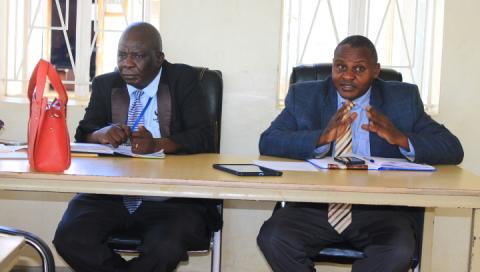
The Deputy CAO Kyenjojo, accompanied by the Deputy CAO Mityana, address the engagement
The visit brings together both technical and political leadership from Mityana to learn from Kyenjojo’s experiences in implementing effective, community-driven nutrition interventions. The engagement focuses on sharing best practices, strengthening coordination, and identifying scalable solutions to common nutrition challenges.
Kyenjojo District showcased its integrated, multi-sectoral approach to nutrition programming—linking health, agriculture, and community development efforts to ensure sustainable impact. Through this model, the district has made strides in promoting dietary diversity, improving food security, and increasing household nutrition awareness.
Particular attention was given to how nutrition interventions are aligned with the Parish Development Model (PDM), ensuring that economic empowerment efforts directly contribute to improved household welfare and nutrition outcomes, helping households improve food security and incomes while encouraging consumption of balanced diets.
While speaking at the meeting, the Deputy Chief Administrative Officer, Kyenjojo, Mr. Yiga Martin Paul, asserted that although malnutrition remains a serious challenge in Kyenjojo, several indicators suggest progress is being made. Thedistrict is fighting malnutrition through a combination of community health outreach, school nutrition programs, agriculture-based interventions, and stronger coordination between departments and partners.
He also told the meeting that emphasis has been put on the promotion of kitchen gardens and school demonstration gardens where communities and schools grow vegetables and nutrient-rich foods such as carrots, beans, and sukuma wiki to improve dietary diversity, strengthening the District Nutrition Coordination Committee (DNCC), which brings together health, agriculture, education, community development, and planning departments to coordinate nutrition interventions and mainstream nutrition into district plans and budgets.
With such interventions in place, malnutrition is on a downward trend, and local leaders report that more households are now consuming at least three meals a day, including vegetables, fruits, and animal protein, compared to previous years.
While visiting Bufunjo Seed Secondary School for a case study, it was realized that school feeding and nutrition garden programs have also reportedly improved school attendance and dietary intake among learners in participating schools.
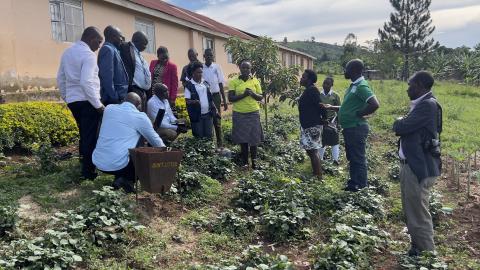
Officials inspect the Nursery bed for vegetables at Bufunjo Seed SS
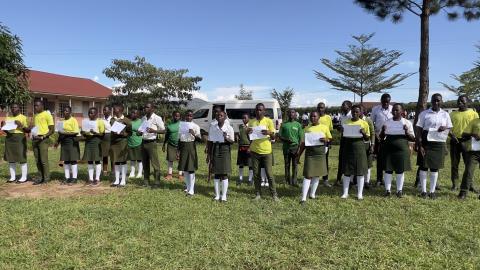
Students of Bufunjo Seed SS recite a poem on the fight against malnutrition during the benchamrking visit
Officials from Mityana District commended Kyenjojo for its strong coordination mechanisms and emphasis on community sensitization, noting that such approaches are critical in driving behavioral change.
Speaking during the visit, Ms. Nabwanika Joyce, the District Nutrition Focal Person for Mityana District, emphasized the importance of benchmarking as a tool for institutional learning and service improvement.
“Learning from districts that are performing well enables us to adopt practical solutions that can transform the lives of our communities,” she noted.
The visit also explored monitoring and evaluation frameworks, with a focus on data-driven planning and tracking progress of nutrition interventions.The benchmarking visit concluded with a renewed commitment from both districts to strengthen collaboration, share knowledge, and scale up successful nutrition initiatives aimed at building healthier and more resilient communities.

Mityana DLG and Kyenjojo DLG Nutrition Committees in a group photo during the visit.